Inspect the exact command order and target used at every step.
Recorded actions, explicit state, repeatable worlds
Datalox
See what the agent did, and what the world became.
Datalox turns documented APIs, approved captures, and simulators into controlled worlds for long-horizon agent runs. Replay every action against explicit state before live access.
13 simulator operations
State after every step
No live hardware attached
Recorded protocol demonstration
A complete run, replayed as state.
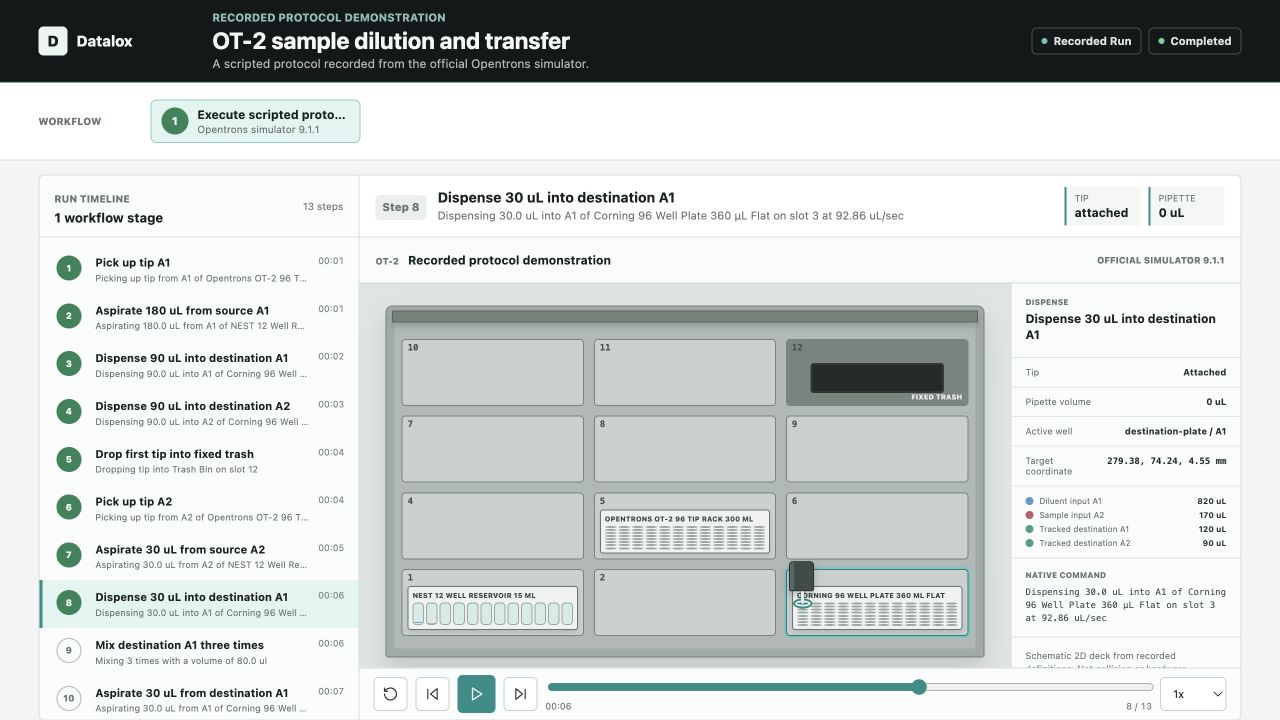
This OT-2 sample dilution and transfer protocol was recorded from the official Opentrons simulator. Move through the run to inspect each native command, target, tip state, pipette volume, and tracked well volume.
DDatalox
Recorded protocol demonstration
OT-2 sample dilution and transfer
A scripted protocol recorded from the official Opentrons simulator.
Recorded run
Completed
Workflow
1Execute scripted protocolOpentrons simulator 9.1.1
OT-2Recorded protocol demonstrationOfficial simulator 9.1.1
00:000 / 13
Example boundary: this is a schematic replay of commands and state recorded from Opentrons simulator 9.1.1. It demonstrates run evidence and state reconstruction, not live-hardware, collision, or protocol-validity certification. Science is one example world, not the product boundary.
Track tip attachment, pipette volume, and well volumes through the run.
Keep labware, slots, wells, and simulator definitions attached to evidence.
Return to the same initial state and compare another agent or model.
World architecture
Ground behavior. Reset the world. Run another agent.
A world defines the provider contract, mutable state, dynamics, observations, provenance, and version. Each run starts from a controlled state, accepts new actions, and produces evidence that can be compared across agents and model versions.
Sources
Provider behavior
API docs and schemas
Test or sandbox probes
Approved captures
Datalox
Interactive world
- Operation contracts
- State and dynamics
- Generated observations
- Provenance and version
Clients
Run controlled scenarios
Training rollouts
Benchmark and eval runs
Regression suites
Ground
Turn source contracts, probes, and approved captures into explicit provider behavior.
Compose
Combine API building blocks into stateful single-provider or multi-provider task worlds.
Reset and run
Restore a controlled initial state, accept new agent actions, and export evidence from every run.
Datalox supplies grounded behavior and worlds, not the agent.
It does not choose models, plan tasks, manage memory, define rewards, or own training. Agents and evaluation systems call a world through its API or MCP surface.
Grounding coverage
API evidence used to construct task worlds.
Datalox combines documented provider maps, locally probed services, and captured behavior cases. Coverage is labeled by evidence level; an executable environment is not presented as proof of unobserved provider behavior.
50executable environment assets
24probed or captured behavior assets
20admitted stateful worlds
Opentrons
open-reference capture 66 cases
RCSB PDB
captured 28 cases
OpenFDA
captured 22 cases
GitHub REST
documented map 27 cases
Datadog
documented map 21 cases
Cromwell
locally probed 14 cases
Work with us
Bring one provider surface or task world.
Tell us which API behavior, mutable state, and task boundary need to be grounded. We can start from one concrete workflow.
contact@complexity-ai.com